
A good travel coloring book earns its place in the bag twice over. On the journey itself it's the quietest, most reliable activity you can hand a restless kid — no battery, no volume, no flat surface required. And in the days before the trip, the right one does something a pack of generic coloring pages can't: it prepares your child for the journey they're about to take.
That second job is the one most parents miss. Below is what makes a travel coloring book actually good, how it changes by journey, and how to get the prep value as well as the peace and quiet.
Why coloring is the ideal travel activity
Strip a journey down and you get a lot of waiting in a small space: the gate, the seat, the highway, the platform. Coloring is built for exactly that. It's lap-sized and self-paced, it occupies just enough attention to crowd out boredom and worry, and it settles an over-stimulated nervous system through the small repetitive motion of the strokes themselves. A child who's melting down at the gate is hard to talk down with words; the same child with a crayon and a single page often downshifts within minutes. (If you want the mechanism, why calming coloring works on an anxious kid lays it out.)
So even a generic travel coloring book is a smart thing to pack. But the format unlocks something more.
The part most parents miss: a coloring book can rehearse the trip
Young children don't fear travel because it's dangerous. They fear it because it's unknown — too many new sounds, smells, and steps arriving all at once with no warning. The single most effective thing you can do is let them meet the day in advance, in a small and safe form, until it's familiar.
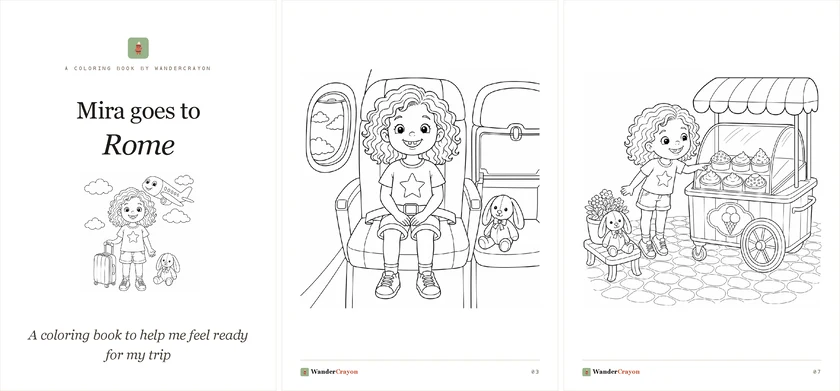
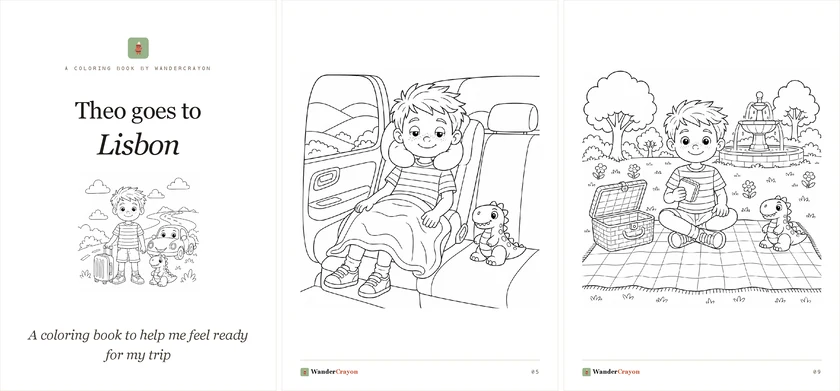
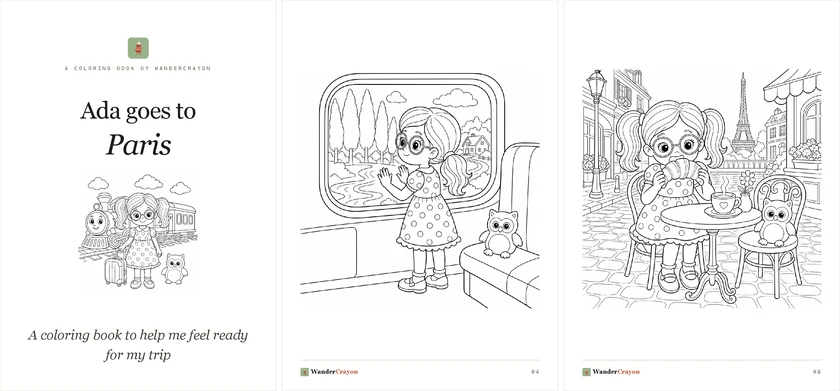
A coloring book is a near-perfect vehicle for that. When the pages walk through the actual journey in order — leaving the house, the security line or the platform, finding the seats, the loud bit, arriving somewhere new — coloring becomes rehearsal. The child meets each step with a crayon in hand instead of for the first time at full volume. This is the same idea as a social story, just in a format kids will happily sit with for twenty minutes.
That's the difference between a travel coloring book and a pile of unrelated coloring pages: one entertains, the other entertains and prepares.
What makes a good travel coloring book for kids
A few traits separate the ones that work from the ones that get abandoned at page two:
- Detail matched to the age. Big, fat regions for a 3-year-old; more intricacy only once they can handle it. Too detailed and you get frustration, which is the opposite of calming.
- Familiar, calming subjects. A plane, a car, a train, a new bed — things from the actual trip, not random novelty. Novelty is stimulation; you want the opposite.
- The journey in order. Pages that follow the real sequence turn coloring into rehearsal instead of just decoration.
- One calm idea per page. A single clear scene, ideally with one simple sentence, beats a busy collage.
- Printable, so you have it tonight. Half the value is using it in the days before you leave, not just on the day.
It changes by journey
"Travel" isn't one thing to a child, and a good coloring book reflects the specific journey ahead:
- Flying. The scary beats are security, the gate wait, takeoff, and the alarmingly loud plane toilet. A plane coloring book that walks through those in order does real work for a nervous flyer — more on that in our guide to an airplane coloring book for nervous flyers, which pairs with where a fear of flying comes from.
- Driving. The hard part isn't a scary moment, it's the long boring middle. Road trip coloring pages work best when they name the stops and the dull stretch directly.
- Trains. The platform gap, finding your seats, the announcements, the connection panic. Our first train journey guide covers the sequence worth rehearsing.
Same tool, different script. The journey decides which pages matter.
Three free sample books to print
Here are three complete WanderCrayon coloring books — one per journey — free to download and print. Each follows one child through their whole trip, in order. Grab whichever matches yours:
Generic printables vs. a personalized one
You can get a long way with a free printable travel coloring book and a bit of effort — print a plane-and-airport pack, and if you're feeling crafty, add a few hand-drawn pages of your own trip in the right order. The structure is what works, not the artwork; a folded sheet of stick figures read at bedtime all week does the job.
The limit of a generic book is that it's about a trip, not your child's trip. The character isn't them, the destination isn't yours, and the specific things your kid is worried about aren't on the page.
That's the gap WanderCrayon fills: answer a few questions about your child and your journey, and it generates a printable coloring book of their exact trip — a character that looks like them, one calm sentence per page, the whole day in order, whether that day is a flight, a drive, or a train. It takes about three minutes, and the few minutes they spend coloring it each evening is quiet rehearsal for the real thing.
Generic or personalized, the move is the same: don't save the coloring book for the journey. Start it the week before, and let your child color the trip once, in order, before it actually happens. (Not sure how to even bring the trip up? Start with how to explain a trip to a young child.)