
A train journey with kids is a different shape of day to a flight. There's no security theater, no jet-bridge tunnel, no strapping a toddler into a seat for three hours. Kids can walk around. They can watch the world move past the window. For a lot of children it's the easiest way to travel.
But a first train ride with a toddler has its own stress points, and they're not the ones parents brace for. The hard parts of a train aren't loud or dramatic. They're the platform, the gap when you board, and the connection: the bits where you're moving fast, watching a clock, and your hands are full.
This guide walks a first train journey with kids in order, the way the day actually happens, so you can rehearse it before you go and run it calmly on the day.
Why a train needs rehearsing too
It's tempting to think a train is so much easier than a plane that you can just turn up. Mostly true. But the thing that tips a young child over isn't difficulty. It's surprise. A train day is still a long sequence of new places in a fixed order your child didn't get to study first: a big echoing station, a board full of numbers, a platform with an edge, a step up onto a moving-looking train, a toilet that makes a strange noise.
The fix is the same one that works for flights: turn the sequence into a script they already know. Walk the day in order, in advance, several times, so the real version is a list your child is checking off with you instead of a string of small ambushes. If you've never built one of these, our guide to making a social story for travel covers the format. It's a pen, some paper, one calm sentence per page.
The train journey, step by step
1. The station
Stations are big and echoey, and that's the first surprise. High ceilings, a swirl of strangers, announcements bouncing off hard surfaces. Name it in advance: "The station is a big building with lots of people. It's loud, but everyone is just catching their train, same as us."
Tell them what you'll do first: find the board, find the platform, find the train. A child who knows the order of those three steps isn't lost in the noise; they're following a plan.
2. Reading the departure board
The big board with all the numbers is genuinely interesting to most kids if you give them a job. Show them in the social story that you'll look for your train's time and find the platform number next to it. On the day, let them be the one to spot it. "Our train leaves at 10:15. Can you find the 10:15? What platform does it say?" A task converts standing-around-waiting into something they're doing.
Name the wait, too. There's almost always a wait at a station. "We wait here until our platform shows up on the board. Then we walk to it." Waiting that's been named in advance isn't a dead spot; it's part of the script.
3. The platform and the gap
This is the real one. The gap between the platform and the train is the single biggest stressor on a train day, and most parents don't think to mention it.
Warnings beat surprises, so warn for it plainly, well before you're standing at the edge with a stroller in one hand:
- The platform has an edge, and you stand back from it until the train stops.
- There's a step up onto the train, and a gap between the platform and the door.
- You hold a hand (or get carried) across the gap. Every time. No exceptions.
A line in the book like "There's a little gap when we step on the train. Mum holds my hand and we step over it together" does a lot of work. The child has already practiced the move in their head. On the day, the gap is the thing they were waiting for, not the thing that scares them.
Practical on-the-day version: board where you can see the gap, take it slowly, and if you've got a buggy, know in advance whether you're lifting it on or folding it. Decide that at home, not on the platform with a queue behind you.
4. Finding your seats
If you have reserved seats, this is its own small adventure: matching the coach letter and seat numbers, which are printed in odd places. Make it a treasure hunt: "We're looking for coach C, seats 41 and 42." If you don't have reservations, explain that too, so an unexpected seat-shuffle doesn't read as a mistake: "Sometimes we sit anywhere that's free. We might move once if someone booked our seat."
Either way, name the goal: we get on, we find our seats, we put the bag up, we sit down. Then the moving-around freedom kicks in, which is the part kids love.
5. The moving scenery
Here's where a train pays you back. Unlike a plane, the window is the entertainment. Set the expectation in the story so they look forward to it: "When the train starts, the houses and trees go whooshing past the window. We can count cows. We can wave at other trains."
Give the motion a name before it happens, too. A train sways and clatters and sometimes lurches when it sets off or brakes. "The train wobbles a bit when it moves. That's normal. We hold our drinks." A child who's been told about the wobble rides it; a child who hasn't grabs the table in alarm.
6. The toilet on board
Train toilets are a classic small horror: a loud flush, sometimes a button-operated door that slides shut with a clunk, occasionally a sink that's confusing. This is the train equivalent of the plane toilet that catches kids off guard.
So narrate it before you go: "The train toilet flushes with a big noise. It's loud but quick. The door is a button: we press it to close it, press it again to open." Show them which button does what before they're inside. The flush stops being a fright the moment it's expected.
7. The announcements
The PA on a train is constant: next stop, this is the quiet coach, please mind your belongings. The voice coming out of the ceiling can unsettle a child the same way it does at an airport. Tell them: "A voice tells everyone the next station. It's not talking to us specially; it's helping people know where to get off."
This also doubles as a tool: teach them to listen for your stop. Now the announcements are useful information they're tracking, not random noise.
8. Changing trains: the connection panic
If your journey has a change, this is where parents tense up, and kids feel that tension. A tight connection with a toddler, a bag, and a platform to find is the most stressful slice of the whole day.
Defuse it in advance and on the day:
- Build the change into the story explicitly. "We get off at the big station, then we find a new platform and get on a second train. It's a little rush, we walk quickly and hold hands." A child who knows a change is coming doesn't read your hurry as something going wrong.
- Know your connection time before you book if you can. With young kids, a 7-minute connection is a gamble; 20–30 minutes lets you find the platform, use the toilet, and breathe. Pay for the longer gap.
- Have the next platform plan ready. Many stations post the connecting platform on the board or on your ticket app. Know where you're heading before you step off, so the change is a walk, not a scramble.
- If the rush does happen, narrate it as part of the plan, not an emergency: "This is the quick walk we talked about. Hold my hand, we're nearly at our next train."
9. Arriving
Name the end clearly, because trains don't always announce your stop as obviously as you'd like, and the doors don't stay open long. "When the voice says our station, we get our bags, stand by the door, and step off (mind the gap again) onto the platform. Then our trip really starts."
Same gap, same hand. End the story on the arrival so the child has a clear finish line to aim for.
What's different from a plane, in one breath
If you've prepped a child for a flight before, recalibrate where the stress lives:
- More freedom, less confinement. No seatbelt-sign captivity. Kids can walk to the window, to the toilet, up the aisle. Use it.
- The stress points move to the edges. Platforms, the gap, and connections, the transitions, are where it's hard. The middle, the long ride itself, is the easy part.
- No big sensory bang. There's no takeoff press or ear-popping descent. The sensory stuff is smaller and more constant: the sway, the flush, the announcements.
If a flight is also on the cards at some point, our first flight with a toddler guide walks that day in the same step-by-step way.
Before you go, and on the day
Before: read the story in order, nightly, in the days before. They'll memorise it, and that's the point. Pack the ordinary toddler kit, plus snacks you can eat without a tray, a small toy or book, and wipes.
On the day: bring the story with you. The most powerful moment for it isn't bedtime the night before. It's your child pointing at the platform page while you're actually standing on the platform, watching for the gap. The book becomes a checklist you're running together in real time.
The convenient version
You can build all of this with a pen, paper, and stick figures; the structure does the work, not the art. Honestly, for a train, a hand-drawn booklet is completely enough.
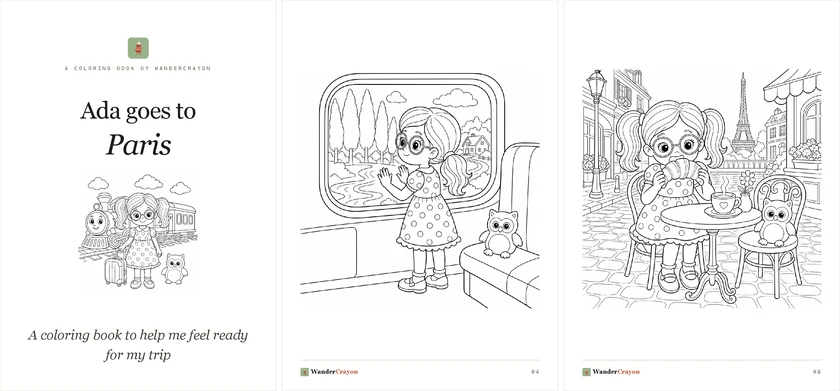
If you'd rather not draw it, that's the gap WanderCrayon fills: answer a few questions about your child and your specific journey, and it generates the whole thing as a printable coloring book: a character that looks like your child, your route, one calm sentence per page, the gap and the connection and the window all in order. About three minutes of questions.
But the format doesn't matter. Walk the day, in order, before the day arrives. Then mind the gap, and have a good trip.