
Most of the advice you'll find for flying with a toddler is written for the flight itself: what to pack in the cabin bag, which snacks, which screen. That part matters. But by the time you're at the gate, the work is mostly done. Or mostly not done.
The thing that decides how a first flight goes for a small child is the rehearsal. Not the snacks. The rehearsal.
This guide is what I'd want a parent to read a week before takeoff, when there's still time for the rehearsal to do its work.
A toddler's problem isn't fear of flying. It's fear of the unknown.
Adults assume kids are scared of the plane. They're rarely scared of the plane specifically. They're scared of being handed, with no warning, into a long sequence of unfamiliar rooms, unfamiliar machines, unfamiliar smells, and unfamiliar rules, and being told to keep up.
A 3-year-old has no schema for "airport." When you say "we're going on holiday," they imagine a vague nice thing. When you arrive at terminal departures at 5 a.m., they discover, with no warning, that "going on holiday" involves:
- A car ride longer than usual
- An enormous building full of strangers walking in straight lines
- An adult taking their shoes off and putting them in a tray on a conveyor belt
- A loud whooshing wand near their tummy
- Sitting strapped into a chair for two hours
- A meal eaten at a strange tilt while the windows show clouds
None of these are scary to us. All of them are scary the first time you meet them with no notice.
The good news is that the fix is not a coping strategy at the airport. The fix is showing them what's about to happen, in order, before it does.
What to do, in the week before the flight
1. Walk them through the day, sequentially
Sit down with them once a day in the week before. Tell them the sequence of the trip, in order. Not "we're going on holiday." This:
"First, we wake up early, when it's still dark. We have breakfast in our pyjamas. We go in the car. The car takes us to the airport. The airport is a really big building. We give the man our suitcase. He puts it on a long belt and it slides away."
Do this every night. They will ask the same questions in the same order. That's the rehearsal working.
2. Name the weird parts before they happen
The bits adults forget are weird:
- Security: shoes off, jacket off, sometimes a wand, sometimes a hand on the shoulder. Tell them this in advance. The wand is the one that surprises children most.
- The jet bridge: "We'll walk down a tunnel. The tunnel is connected to the plane. The plane is at the other end of the tunnel."
- Takeoff: "The plane goes very fast. Then it tips backwards. Then the ground goes away. Your tummy might feel funny. That means it's working."
- Ear popping: "Sometimes your ears feel a bit blocked. Yawning or chewing helps."
- Toilets: "The plane toilet makes a really loud sound when you flush. It's meant to be loud. It can be a bit surprising the first time."
Toilets in particular. Many small children refuse to use plane toilets because of the flush noise. Tell them.
3. Show them pictures and let them ask
Photos of the inside of an airport. Photos of a window seat. Photos of the security line. Photos of the meal tray. Photos of the seatbelt sign.
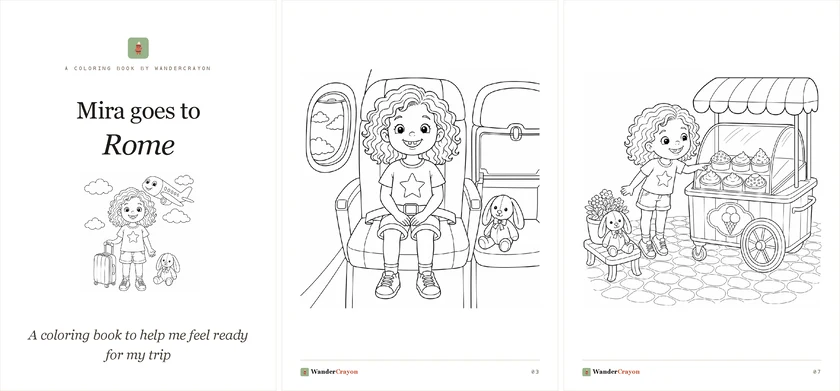
What you're building here, whether you call it that or not, is a social story: an ordered, illustrated walkthrough of the day, gone over in advance until the day stops being new. A coloring book of the trip works particularly well as one because the child fills it in. They go from passive viewer to active narrator. They tell you what happens at security. That's a different brain state from being told.
If you'd like a personalized one starring your child and your specific trip, WanderCrayon makes them.
4. Practice the strap-in
A real seat belt is sometimes the surprise on board. Practice the belt in the car. Practice waiting with the belt on. Practice not getting up because the belt is on.
5. Talk about what's at the other end
This is the bit that gets skipped. Children get told "we're going to grandma's" but no one ever describes grandma's house. Where they'll sleep. What the bed looks like. Whether they'll have their own room. What time they'll eat.
A child who knows what bed they're sleeping in tonight worries less about the plane.
What to pack for the flight itself
Less than the internet says. (The full tick-it-off version, from two weeks out to the day itself, is in our flying with kids checklist.)
- A familiar comfort item. Their actual bedtime one, not a substitute.
- A small bag they can carry. Even a 3-year-old can have a backpack. Agency reduces anxiety.
- Snacks they will definitely eat, not snacks you wish they ate.
- One new small toy, kept secret until 30 minutes before boarding.
- Spare clothes for both of you, including a top for you. Spills land on grown-ups.
- A picture book of the trip if you have one, for the gate and the takeoff. Coloring works too.
That's it. The temptation is to bring a circus. The circus tires both of you out before takeoff.
At the airport
Get there early. The single biggest thing you can do for a toddler's first airport experience is have no time pressure yourself. They read your nervous system before they read the situation. A calm, unhurried adult is the variable that matters.
A few specifics:
- Let them help. Carry their own bag. Hand the boarding pass to the gate agent. Press the lift button. Toddlers under stress regulate by feeling useful.
- Snack before security, not after. Empty bellies + queue = unhappy.
- Tell them what's coming, again, as you go. "Now we're going to security. Remember, shoes off, in the tray."
- Pre-warn the wand. If they get a hand-wand check, narrate it: "The lady is going to wave a thing near your tummy. It's just checking for tickets. It doesn't touch you."
Takeoff
The single moment most parents worry about. Usually fine. Two things to know:
-
Their ears. Toddlers' eustachian tubes are narrow. The popping is more uncomfortable for them than for you. Give them something to chew or suck: a drink, a snack, a lollipop. Yawning works. If they cry on descent, it's almost certainly ears.
-
The push back into the seat. This is the bit they didn't know was coming, even after all your rehearsing. Hold their hand. Say "this is the bit where it goes fast. It only lasts a minute. Then we level out."
After about 90 seconds, the cabin settles. The window goes from runway to clouds. You can let them watch out the window now, and most toddlers find this fascinating. The clouds are the part of the rehearsal they were most looking forward to. Let them have it.
On board
Set expectations low. A toddler will not sit and read for two hours. Plan for them to:
- Eat something
- Look out the window
- Be a bit confused for 20 minutes
- Need the toilet at the worst possible moment
- Sleep for an hour, possibly
- Lose patience in the last 30 minutes
That's a successful flight. If they cry, they cry. The other passengers were toddlers once. The good ones remember. (For the moment-by-moment toolkit — telling ear pain from boredom from overwhelm, and what fixes each — see how to calm a toddler on a plane.)
When you arrive
This is the bit forgotten in all the prep:
- A new bed is its own anxiety event.
- Walk them around the new place when you arrive. Show them where they sleep. Show them where the toilet is. Show them the kitchen.
- Bring their pillow from home if you can. It's a tiny thing that helps a lot.
- The first night sleep will be bad. Expect it. The second night is almost always fine.
On neurodivergent kids and first flights
If your child is autistic, has ADHD, or is sensory-sensitive, everything in this guide goes double. The rehearsal isn't optional, it's the entire intervention. A predictable, ordered social story of the day, one you go over many times, is closer to therapy than to entertainment.
We wrote a longer guide on this: Flying with an autistic child: what helps (and what doesn't).
A small thing to hand them before the journey
You can build the rehearsal verbally, with photos from the internet, with a homemade book. You can also have a personalized coloring book of their trip generated in a few minutes, starring a character that looks like them, walking through the actual day, with one calm sentence on each page.
That's what WanderCrayon does. The point isn't the coloring. It's that they read the trip back to you, which is the moment you know the rehearsal worked.
The trip is coming. The rehearsal is the work. Good luck.