
This post is not a packing list. If you want the nuts and bolts of getting a small child through an airport, that lives in our first flight with a toddler guide. This is about the harder, less practical thing: the feeling. Why a child is afraid to fly, what's actually going on in their head, and what you can do about it before you're standing at the gate with a kid who's already crying.
This is practical parenting guidance, not medical or therapeutic advice. If the fear is intense, lasting, or part of a wider pattern, talk to your pediatrician or a child psychologist — there's more on that below.
Fear of flying in children is common, and it's usually not about the plane itself. It's about four things underneath it. Name them, and most of the fear becomes workable.
Where the fear actually comes from
1. Loss of control
A flight is the one situation where a child has almost no agency. They can't leave. They can't see where they're going. A stranger decides when they sit, when they stand, when the doors open. For a small person whose whole sense of safety runs on "I can get to my grown-up and we can leave if it's bad," that's a lot to hand over at once.
You can't give them control of the plane. But you can give them control of the information, which is the next best thing, and the thing this whole approach turns on.
2. Sensory overwhelm
Airports and planes are loud, bright, crowded, and full of sudden inputs: the PA system, the engine spool-up, the toilet flush, the pressure on the ears at descent. A child scared of planes is often, underneath, a child whose senses are about to be ambushed by things no one warned them about.
3. Catastrophic imagination
Young kids are spectacular catastrophizers. A 3-to-8-year-old doesn't have the frame to think "planes are statistically the safest way to travel." They have a frame that thinks "we are very high up and I can feel it." If no one fills the gap with concrete, accurate information, their imagination fills it for them, and imagination always picks the worst version.
4. The fear they catch from you
This is the big one, and the one parents least want to hear. Children read your nervous system before they read your words. If you white-knuckle the armrest at takeoff, scan the cabin crew's faces at every bump, or go tense and quiet during the safety briefing, your child clocks all of it. They don't know what it means. They just know the person who keeps them safe is scared. So the situation must be genuinely dangerous.
A lot of "my child is afraid to fly" is, honestly, "my child can tell I'm afraid to fly." That's not a criticism. It's the most fixable cause on this list, because it starts with you.
How to help a child scared of flying: what to say (and what not to)
The instinct, when a child is scared, is to make the fear disappear by denying it. That backfires. Here's the difference.
Don't say:
- "There's nothing to be scared of." This tells a frightened child their feeling is wrong, which adds a second problem on top of the first.
- "It's totally safe, don't worry." Vague reassurance lands as "the grown-up isn't really listening." Kids want specifics, not comfort-noise.
- "Don't think about it." Now it's all they'll think about.
- Nothing at all. Saying nothing to avoid "planting" the fear doesn't work. The fear's already there. Silence just means they face it alone.
Do say:
- Name the feeling first: "You're nervous about the plane. That makes sense, you've never done it before."
- Then narrate the facts, concretely: "Planes are built to fly. The pilots do this every single day. The bumps are just the plane bouncing on air, like a car on a bumpy road."
- Pre-warn the hard parts by name: "When we go fast at the start, you'll feel pushed back into your seat. That part means it's working."
That last one matters most. Warnings beat surprises, every time. A child who's told "the toilet makes a loud WHOOSH, it's quick" nods when it happens. A child who isn't told jumps, decides the plane is broken, and now you're managing a meltdown at 30,000 feet. Never hide the scary bits. Name them in advance, in calm, present-tense language, and the scary bits lose most of their teeth.
Rehearsal is the real intervention
Here's the mechanism that ties all four causes together. The thing that frightens kids about flying is that it's a long sequence of unfamiliar things, in an order they never got to study first. Each step is a small surprise, and surprises are what tip a nervous, tired child over the edge.
So you take the sequence and you turn it into a script they already know.
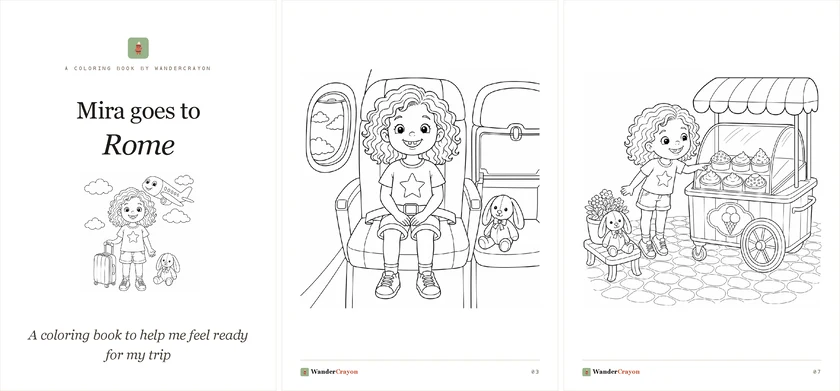
You walk them through the whole day, in order, several times, before it happens: the morning, the drive, the big airport, the suitcase going away, security, the wait at the gate, boarding, the push of takeoff, the bumps, the descent, the new bed at the end. When a child has met every step on paper first, the real version stops being an ambush. It becomes a checklist they're ticking off with you.
This is a gentle, everyday version of the same idea therapists often use for anxiety: small, safe exposure. You're not throwing the child in the deep end. You're letting them meet the scary thing in a controlled form, repeatedly, until it's boring. A coloring book works unusually well for this, because the child does something with each page: they color the security line, then tell you what happens there. Passive listening becomes active rehearsal.
If you want the full how-to, our guide to making a social story for a trip breaks down the structure step by step. You can build one tonight with printer paper and stick figures.
Managing your own visible anxiety
If you're an anxious flyer yourself, this is some of the highest-leverage work you can do. You don't have to not be scared. You have to not broadcast it. Some specifics:
- Do your own prep separately. Read up on turbulence (it's uncomfortable, not dangerous). Knowing why the plane bumps makes the bumps easier to sit through with a calm face.
- Have a plan for your own body at takeoff. Slow breathing, a podcast, a hand on your child instead of the armrest. Whatever keeps your shoulders down.
- Narrate calmly out loud, for both of you. "That's just the wheels folding up. Normal noise." Saying it steadies the child and steadies you.
- Don't perform fearlessness you don't feel. Kids see through it. Aim for calm and honest ("I get a little nervous at the start too, and then it's fine"), not fake.
A parent who manages their own nerves out loud is teaching the child the most useful skill there is: feeling scared and being okay anyway.
When it's normal, and when to ask for help
A bit of nervousness before a first flight is completely normal. So is some clinginess, a few "what if" questions, a rough night's sleep before the trip. Most of it resolves with preparation and one or two uneventful flights under their belt.
It's worth a conversation with your pediatrician or a child psychologist if the fear:
- Is intense and persistent, lasting well beyond the trip itself
- Spills into daily life: refusing school trips, panic at the mention of travel, trouble sleeping for weeks
- Comes with physical symptoms like a racing heart, stomach pain, or panic that you can't talk them down from
- Is part of a wider pattern of anxiety across lots of situations, not just flying
None of that means anything is wrong with your child. Childhood anxiety is common and very treatable, and a professional has tools beyond a coloring book. The point of this post is the ordinary, garden-variety nerves, which is most cases, and which good preparation handles well.
Common questions about a child's fear of flying
How do I help my child not be scared of flying?
Name the feeling instead of denying it, tell the truth about what the flight will actually feel like (including the loud and bumpy parts), rehearse the whole day in order before you go, and keep your own face calm. The rehearsal — letting them meet each step in advance until it's familiar — does most of the work.
Is it normal for a child to be scared of flying?
Yes. A fear of flying is common in children, and it usually isn't about the plane itself — it's about loss of control, sensory overload, and not knowing what's coming. For most kids it fades with preparation and one or two uneventful flights.
How do I calm a child who's scared of flying during the flight?
Pre-warn each phase as it arrives ("now we go fast and you'll feel pushed back into your seat"), narrate the noises as normal, keep the comfort item in reach, and stay visibly calm yourself. A child who was walked through the day in advance has far less to be surprised by. For the mid-flight toolkit — ears, boredom, the seatbelt-sign trap — see our guide to calming a toddler on a plane.
When should I be concerned about my child's fear of flying?
If the fear is intense and persistent, spills into everyday life, comes with physical symptoms like a racing heart or stomach pain, or is part of broader anxiety across many situations, talk to your pediatrician or a child psychologist.
The short version
Fear of flying in children comes from loss of control, sensory overwhelm, a runaway imagination, and the nerves they pick up from you. You can't remove the flight. You can remove the surprise:
- Name the feeling instead of denying it.
- Tell the truth, concretely, including the hard parts.
- Rehearse the whole day in order, in advance, until it's familiar.
- Keep your own face calm, or honestly explain the nerves you can't hide.
That's the work, and most of it is free. You can do it with a pen, a printer, and a quiet half-hour. If you'd rather not draw it yourself, WanderCrayon builds the rehearsal version automatically: a printable coloring book starring a character that looks like your child, walking through your exact trip, one calm sentence per page. It takes about three minutes of questions.
But the tool isn't the point. The rehearsal is. Walk them through the day before the day arrives, and the fear has a lot less room to grow. Have a good flight.