
You're somewhere over the Atlantic, the seatbelt sign is on, and your toddler has decided the flight is over. Everything below is written for that moment — and for the smarter version of you, a week earlier, who can prevent half of it.
The single most useful idea: "calm the toddler" is five different problems wearing the same scream. Ears, restraint, overwhelm, boredom, and tiredness each have a different fix, and the fastest way to a calm child is diagnosing which one you're holding.
First, work out which problem you have
- Ears. Crying that starts or spikes as the plane climbs or — much more often — descends is ear pain, not emotion. Toddlers' ear tubes are narrow and the pressure genuinely hurts. Fix: swallowing and chewing. A bottle, a sippy cup, a chewy snack, a lollipop, exaggerated yawns you model yourself. Start it as descent begins, not when the tears do.
- Restraint. A toddler strapped into a seat they can't leave is a toddler in a fight with physics. Fix: don't argue the belt, shrink the sentence. "When the ding sounds, we can get up." Give the belt a job: they buckle it, they check yours, they're the belt inspector. Agency calms faster than distraction.
- Overwhelm. Wide eyes, hands to ears, turning into your chest: too much input, not too little. Fix: subtract. Shade down, screen off, your arms around them, the familiar comfort item, your quietest voice. You can't remove the engine noise, but you can stop adding to it.
- Boredom. Whining, wriggling, seat-kicking. Fix: one thing at a time. A toddler offered the whole activity bag burns through it in eleven minutes; a toddler offered one thing, then later a different thing, gets ninety. The window is an activity: narrate the clouds, hunt for other planes, look for the sea.
- Tiredness. Past a certain point nothing on this list works because the child needs to be asleep. Fix: stop entertaining and start the bedtime script — comfort item, dimmed light, the same phrase you use at home. Make the nap possible and then let it come.
Takeoff: the ninety seconds to narrate
The push of takeoff is the moment least like anything a toddler knows, and it arrives with a roar. Hold their hand and narrate it as it happens, in the calm voice of someone describing weather: "Now we go fast. You'll feel pushed back in your seat — that means it's working. Now we tip up. Now the ground gets small."
Pre-warned beats surprised, every time. And they read your body before your words: shoulders down, slow voice, boring face. A toddler checks your face at every new noise, and your face is allowed to say this is normal even if your stomach doesn't agree. If flying nerves run in the family — theirs or yours — our guide to fear of flying in children covers that layer properly.
The middle: rotate, don't pour
Set expectations at "toddler on a chair for two hours," not "peaceful angel." A successful flight is: eat something, window for a while, one activity, brief confusion, possibly a nap, patience lost in the final thirty minutes. That's a good flight.
Tactics that earn their place:
- One new small thing, produced mid-flight, not at the gate. Novelty is fuel; don't burn it on the runway.
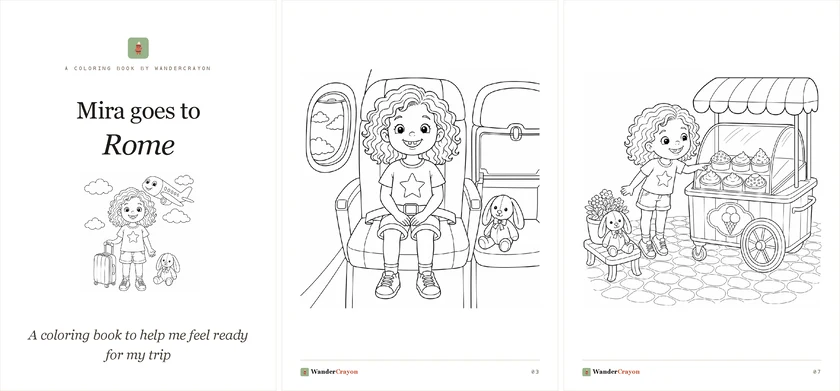
- Coloring in the seatback tray. It's contained, it's quiet, and bounded, repetitive coloring genuinely settles an aroused nervous system — it's the same reason a coloring book of the trip itself doubles as rehearsal.
- Snacks as events, not grazing. Unwrapping is half the entertainment. Save one for descent on purpose (see ears, above).
- A walk to the toilet when the sign is off — even if nobody needs it. Movement resets a wriggly child, and the loud flush is a rite of passage you've hopefully pre-warned.
What doesn't work
- Shushing and threats. A dysregulated two-year-old cannot comply their way to calm; volume from you adds arousal to a child already over the line.
- Sugar as a peace offering. You're trading five quiet minutes for a wired hour in a seat.
- The circus. Fifteen activities perform worse than four, deployed one at a time.
- Screens as the entire plan. Fine as one tool — but the tablet dies, descent requires ears-attention, and a toddler yanked off a screen mid-episode is angrier than one who never had it. Have a non-screen layer.
- Apologising to the cabin. If they cry, they cry. Ears and tiredness aren't parenting failures, and the other passengers were toddlers once. Work the problem, not the audience.
Descent: the part everyone forgets
Takeoff gets the anxiety, but descent is where flights actually fall apart: ears hurt more going down, everyone's tired, the screen goes off, and the "nearly there" wait is long. Plan for it as its own event — the saved snack comes out as the plane starts down, chewing and drinking begin before the pain, and the last job is announced: "When we feel the little bump, we've landed, and you can say hello to the new place."
The honest part: most of this is bought before you board
Everything above helps. But the calmest toddlers on planes are the ones for whom nothing on the flight is a surprise — because they met the whole day in advance: the airport, the belt, the roar, the funny tummy, the ding, the loud toilet, the ears. A toddler encountering all of that unbriefed is being ambushed hourly; the in-flight tactics are just triage.
The walkthrough takes a week of bedtimes and costs nothing — our first flight with a toddler guide is the full version. If you'd rather hand them the rehearsal than perform it, WanderCrayon turns your actual trip into a printable coloring book: a character that looks like your child walking through your real flight, one calm sentence per page. They color the takeoff before they feel it.
Common questions about calming a toddler on a plane
How do I calm my toddler down on a plane?
First work out which problem you have: ear pain, restraint frustration, overstimulation, boredom, or overtiredness each need a different fix. Give them something to suck or chew for ears, a job and a countdown for the seatbelt, dimmed light and a familiar comfort item for overwhelm, one activity at a time for boredom, and a made-up "bed" instead of a fight for tiredness. Keep your own voice slow and low — they regulate off you.
Why do toddlers cry on planes?
Most commonly: ear pain from pressure changes (especially on descent), being strapped into a seat they can't leave, sensory overload from the noise and lights, plain boredom, or being overtired at an odd hour. Crying at descent is almost always ears — give them something to drink, suck, or chew.
What helps a toddler's ears on a plane?
Swallowing and chewing open the ear tubes: a bottle, a sippy cup, a lollipop, a chewy snack, or exaggerated yawning. Time it for takeoff and — more importantly — for the start of descent, which is when ears actually hurt most. Starting the drink or snack as the plane begins to go down works better than waiting for tears.