
A flight is loud and dramatic and over in a few hours. A long car journey with kids is the opposite problem: it's long, it's monotonous, and the hard part isn't a single scary moment. It's the middle, the stretch of nothing where a toddler runs out of patience two hours before you run out of road.
You can't entertain your way out of that with enough snacks. What actually helps is the same thing that helps with a flight: prep the child for the shape of the day before you set off, so the boring middle and the endless seatbelt aren't a nasty surprise.
The car is a sequence too, it just doesn't look like one
With a flight, the steps are obvious: check-in, security, gate, takeoff. A drive feels like one undifferentiated blob of "being in the car." But to a three-year-old it's still a long sequence of things in an order they didn't get to study first: buckle in, the highway, the first stop, more highway, lunch, the bit where it gets boring, the bit where it gets dark, and then a strange new place at the end.
Turn that blob into a script they already know and a road trip with a toddler stops being a test of endurance for everyone. The child isn't enduring an unknown; they're tracking a list they recognize.
This is the social-story idea applied to a drive. (If "social story" is new to you, we walk through the whole concept in what a social story is and how to make one.)
Before the trip: prep the route, not just the bag
1. Walk them through the drive in order
The before-the-journey rehearsal is the same as for any trip: tell the day in order, one step at a time. For a road trip with kids it looks roughly like this:
- The morning: getting dressed, the bags going in the trunk
- Getting buckled into the car seat
- Setting off: the streets you know, then the big road
- The long bit, name it directly (more on this below)
- The first stop: the bathroom, a snack, a run-around
- Back in the seat, more driving
- Lunch somewhere new
- The last stretch, "nearly there now"
- Arriving: a new room, maybe a new bed
Read it. Let them point at the stops. Memorising the order is the point. It's what stops every transition from landing as a small shock.
2. Name the boring middle out loud
This is the one most parents skip, and it's the one that matters most for a car. Don't sell the drive as nonstop fun. Tell the truth:
"There's a long part in the middle where we just drive and drive. It's a bit boring. That part is normal. We've got songs and snacks for it."
A toddler who's been told the boring stretch is coming handles it far better than one who expected excitement and got a highway. Warnings beat surprises, and "this part is boring and that's okay" is a warning worth giving.
3. Set honest expectations about time
Toddlers have no concept of "four hours." So don't use hours, use landmarks they can feel. Tie the timeline to the stops:
- "We drive until the first stop. We have a snack there."
- "Then we drive until lunch."
- "Then one more drive, and we're there."
Three legs they can count beats one number they can't picture. It also quietly answers "are we there yet" before it's asked: the answer becomes "after the next stop," which is a thing they can hold onto.
4. Practice the car seat if it's a battle
If your child fights the car seat on a ten-minute trip to the shops, an eight-hour drive will not go better by hope alone. In the week before, do a couple of slightly longer practice drives. Let the seat, the harness, and the view become familiar before the day you need them familiar.
On the road: the rhythm of the day
Stop more than feels efficient
The single biggest mistake on a long car journey with kids is the heroic non-stop push to "make good time." A toddler's body cannot do four hours in a seat. Plan a real stop roughly every 90 minutes to two hours, not a gas-station-and-go, an actual ten minutes of running around.
Build the stops into the social story beforehand so they're part of the script, not a negotiation. A page that says "We stop at the big service station. I run around. Then we get back in" sets the expectation that stops are scheduled, not begged for.
Make "are we there yet" answerable
"Are we there yet" is really the question "how much of this unknown is left?", and the cure is information they can verify themselves. A few options that work:
- A simple stop-counter. Three stickers on a card, one peeled off at each stop. They can see the trip shrinking.
- The book as a checklist. If you've got a social story, point at the current page. "We're here, the lunch stop. After this, one more drive."
- A landmark they'll recognize. "When you see the big bridge, we're nearly there."
The goal is the same as everything else here: replace the open-ended unknown with a finite thing they can track.
Comfort in the seat
A car seat is a small, fixed, slightly boring place to spend a day. A few concrete things help:
- Dress in layers. Cars swing from freezing to baking. A kid who's too hot in a five-point harness and can't tell you why just melts down.
- Loose, soft clothes. No stiff seams or chunky buckles under the harness straps.
- The actual comfort item within reach. Not in the trunk. The one they want at the exact moment they want it.
- Sun shade on their window. Low afternoon sun straight in the eyes is a common, fixable source of misery.
- Sips, not a big drink. A bottle of water that triggers an unscheduled emergency bathroom stop helps no one.
Narrate, don't just distract
Screens and snacks have their place, and that place is the long middle. But when the mood tips, narrating beats distracting, same as on a plane. "I know, this part is long. Two more songs and we stop and you can run." Naming where you are in the day gives a toddler something solid to stand on. Pretending the boring part isn't happening doesn't.
The arrival
The drive ends somewhere that isn't home, and arrival is its own small transition, easy to forget when you're just relieved to be parked. Close the loop:
- Walk them through the new place when you get in. Show them which bed is theirs.
- Don't expect them to be delighted the second the engine stops. A long drive is genuinely tiring; a slow, low-key first evening beats a packed one.
- Keep one home routine intact: the bedtime story, the specific cup, whatever it is. One familiar thing in a new room does a lot.
You can build this with a pen
None of this needs an app. You can fold a few sheets of paper, draw stick figures of the car, the stops, and the new bed, and read it at bedtime all week. The structure is what works, not the artwork.
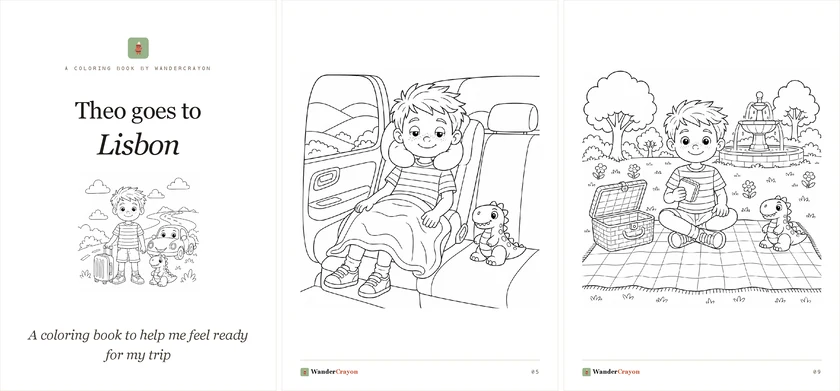
If you'd rather not draw it yourself, that's the gap WanderCrayon fills: answer a few questions about your child and your route, and it makes the whole drive into a printable coloring book: a character that looks like your child, one calm sentence per page, the stops and the boring middle and the arrival all in order. It takes about three minutes, and they color it in the days before, which turns a passive read into active rehearsal.
But the format honestly doesn't matter. Drawn, printed, or just told aloud from the front seat, what matters is that your toddler gets to drive the trip once, in order, before the real one starts. (If a first flight is in your future too, the first flight with a toddler guide takes the same approach to the air.)
Prep the route. Name the boring bit. Stop often. Have a good drive.