
Most parents discover calming coloring by accident — a waiting room running late, a meltdown brewing, a single page and three crayons handed over in desperation, and ten minutes later a child who's breathing normally again. Once you've seen it work, the natural next step is to go looking for "calming coloring pages" on purpose.
This is the practical guide to that: what actually makes a coloring page calming (not all of them are), how to use them so they settle a child instead of frustrating one, and how to aim that calm at a specific worry. If you want the underlying why — the attention science, the rhythm, the research — that's in why a box of crayons works on an anxious kid. This piece is about doing it.
What makes a coloring page calming, not just busy
Search results will hand you everything from toddler shapes to hyper-detailed mandalas, and the wrong page actively backfires — a page that's too intricate produces frustration, which is the exact opposite of calm. The pages that reliably settle a child share a few traits:
- Bounded, repeated shapes. Clear regions to fill and patterns that repeat. The repetition is doing the regulating, the same way rocking or pacing does.
- Detail matched to the age. Big, fat regions for a 3-year-old; more intricacy only once an older child can handle it without getting stressed. When in doubt, simpler.
- A familiar, gentle subject. A dog, a house, a train. Novelty is stimulation, and you're trying to dial stimulation down.
- One page, not a pile. A stack of options is just another set of decisions to make. Hand over a single page.
If a "calming" coloring page is dense, fiddly, or busy, it isn't calming — it's a small homework assignment. Pass on it.
How to use them so they actually calm
The page is only half of it. How you hand it over matters just as much:
- Crayons over felt-tips. Crayons push back against the paper, and that bit of resistance gives the hand something to feel — it's part of why the activity regulates. Felt-tips glide and lose that feedback.
- Sit alongside and color your own. Don't supervise. Side-by-side, hands busy, no eye contact, is also when kids talk — the worry tends to come out sideways, mid-stroke, unprompted.
- No art direction. The second you correct a color choice, performance pressure walks back in and the calm walks out. Green sky, purple dog — that's the deal.
- Let it be a downshift, not a fix. Coloring reliably buys you a calmer child for the next half hour. It doesn't resolve what made them anxious in the first place — that's a separate conversation, and for persistent anxiety, one worth having with a professional.
Point the calm at the actual worry
Any calming coloring page gives you the downshift. But there's an upgrade that most people never think of: have the child color the thing they're actually worried about.
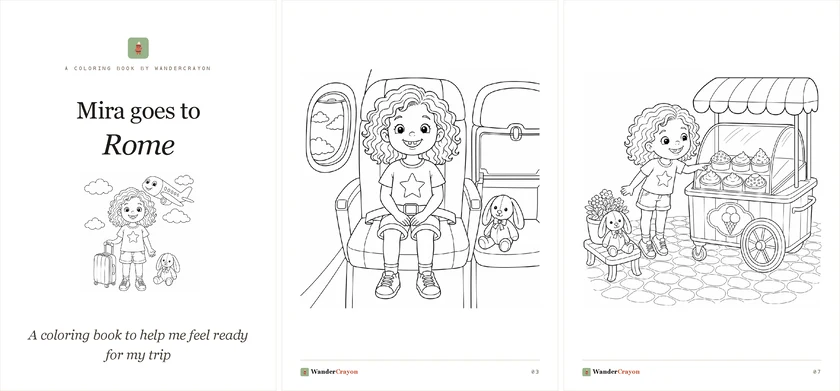
A child anxious about a flight who colors a generic unicorn gets calmer. A child who colors the security line, the gate, the plane taking off — in order, page by page — gets calmer and rehearses the scary thing into familiarity. Same crayons, far more mileage. It's the gentle version of how therapists treat a fear: not avoidance, but small, safe, repeated exposure. This works for whatever the worry is — a first flight, a night-before-the-trip case of nerves, a fear of flying, the first day of something new.
The principle: a calming coloring page settles the body; a calming coloring page of the worry settles the body and shrinks the worry at the same time.
Print some tonight
You don't need anything fancy to start. Plenty of free printable calming coloring pages are a search away, and the homemade route works just as well — fold a few sheets of paper, draw simple bounded shapes (or the steps of whatever's worrying them), and you've got a calming book for the cost of some paper and ten minutes. The structure does the work, not the artwork.
Where it gets more powerful is when the pages are calming and specific to your child's situation. That's what WanderCrayon is for: answer a few questions about your child and an upcoming trip, and it generates a printable coloring book built to calm — bounded, age-matched pages, a character that looks like them, one gentle sentence each, the worrying day laid out in order. It takes about three minutes to make, and the quiet half hour they spend coloring it is doing two things at once.
But you can start tonight with nothing but a printer and a tin of crayons. Pick a simple page, sit down next to them, color your own, and don't mention the worry. More often than not, it comes up on its own, somewhere around page three.