
Ask a child afterwards which part of flight day was scary, and it's usually not the flying. It's the airport: an enormous, echoing building where the suitcase disappears, strangers in uniforms give instructions, shoes come off in public, and everyone walks through a beeping doorway one at a time. The plane has a window and a snack. The airport has procedures.
That's why the airport deserves its own social story — an ordered, illustrated walkthrough of exactly what happens between the terminal doors and the airplane door, read out loud in the days before. This post gives you the sequence, the sentences, and the parts to slow down on. If you're new to social stories in general — what they are, why they work — start with our plain-English guide; if you want the whole flight day including takeoff and landing, that's the social story for flying.
The airport, in the order your story should tell it
One step per page, in the true order. For most airports, that's:
- Arriving: the airport is a very big building, with more people than the supermarket
- Check-in: we show our tickets, and the big suitcase rides away on a belt — on purpose
- The security line: we wait our turn, shuffling forward a little at a time
- The trays: shoes, jackets, and bags go in trays and slide through a special window
- The arch: I walk through a doorway that checks everyone, all by myself, and my grown-up is right there on the other side
- Sometimes: a wand, or a gentle pat on my clothes — it's just checking, it's quick
- Finding our gate: we follow the yellow signs down long corridors
- The wait: we sit by the big windows and wait for our plane; waiting is part of flying
- Boarding: our number is called, we walk down a tunnel, and the plane is at the end
Nine pages, one calm sentence each. That's the whole document.
Security deserves three pages, not one
Most homemade airport stories compress security into "then we go through security," and security is precisely the part that needs the opposite treatment. To a five-year-old, security is four separate strange events in a row:
- The line. Long, slow, and full of a feeling children read instantly: grown-ups being tense. One page: "We wait in a line that moves slowly. Everyone waits. I can hold my grown-up's hand."
- The tray. Their backpack — possibly with the comfort item inside — slides away into a machine. Pre-warn it, and let them push the tray onto the rollers themselves if the agent allows; doing beats watching. "My bag goes in a tray. It slides through a special window and comes out the other side. I get it right back."
- The arch. The one moment of the whole day a small child is asked to walk away from their parent, alone, through a machine that might beep. It's three steps and two seconds, but it's their hardest page: "I walk through the doorway all by myself. Mama is right there on the other side, watching me the whole time. Sometimes it beeps. The beep just means a person checks again."
- The wand or pat-down. It doesn't happen every time, which is exactly why it belongs in the story — a surprise inspection is much worse than a rehearsed one. "Sometimes a worker waves a special wand near my clothes, or pats my shoulders gently. It is quick, and it doesn't hurt. It's just checking."
Warnings beat surprises. Nowhere in the airport is that more true than security.
The wait is a real step. Give it a page.
Children rehearse the exciting parts — the plane! the tunnel! — and then hit forty minutes of nothing at the gate. The gap between "we're at the airport!" and "we're on the plane" is where a lot of meltdowns actually happen, purely because nobody told them the gap existed.
So the wait goes in the story as its own step, with a job attached: "We sit by the big windows and wait for our plane. Waiting is part of flying. I can watch the planes and color while we wait." A child who knows the wait is coming treats it as a step to tick off. A child who doesn't treats it as the plan going wrong.
If your child is autistic
Social stories come from autism practice, and the airport — with its queues, uniforms, PA announcements, and one-way flow — is the part of travel day where autistic kids most need the script in advance. Two extra layers help:
- Rehearse security physically at home. A doorframe as the arch, a tray for the shoes, walking through alone while you wait on the other side. Two minutes of play, repeated a few times, takes most of the strangeness out of the real one.
- Ask your airport what it offers. Many airports run assistance programs for hidden disabilities: sunflower lanyards that quietly signal staff to slow down, quieter security lanes, sensory rooms near the gates, and — at some airports — practice visits where you can walk the real terminal before travel day. Search your airport's name plus "special assistance" or "sunflower lanyard," and ask the airline too; this costs nothing and changes the day.
Our guide to flying with an autistic child covers the whole flight-day layer — sensory kit, boarding choices, what to ask for.
Read it nightly, then point at the pages in the real airport
The story works through repetition: read it at bedtime for the week before, until your child is saying the lines with you. Then bring it in the cabin bag. Its most powerful moment is in the security line itself — open to the security page, point, and let them check off the real thing against the drawing. The book stops being a story and becomes a checklist the child is ticking off, and a child who is checking is a child who isn't scared.
Making yours tonight
The homemade version costs three sheets of paper: fold, staple, one step per page, one calm sentence, a stick-figure drawing to color. The order does the work, not the art.
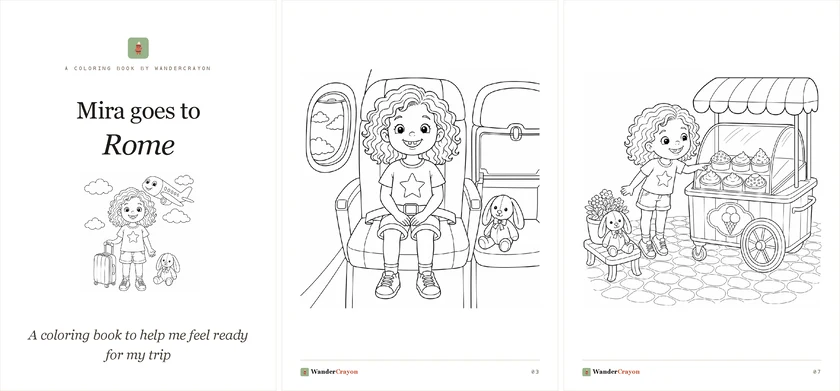
If you'd rather not draw nine pages, WanderCrayon generates the whole thing as a printable coloring book: your actual journey in order — airport steps included — starring a character that looks like your child, one calm sentence per page. About three minutes of questions, and the coloring turns each page into rehearsal they do instead of rehearsal they hear.
Either way: the airport in order, security in small pieces, the wait named, the book brought along. Have a good trip.
Common questions about airport social stories
What is a social story for the airport?
An ordered, illustrated walkthrough of the airport visit — the big building, the suitcase going away, the security line, the scanner arch, the gate wait, boarding — written in calm, present-tense sentences from the child's point of view and read out loud in the days before. The child meets each step on paper first, so the real airport stops being a string of surprises.
What should an airport social story include?
Every step in the true order: arriving, the size and noise of the terminal, check-in and the suitcase leaving on the belt, the security line, the tray, the scanner arch (and the possibility of a wand or pat-down), finding the gate, the wait, and boarding. Security should get two or three pages of its own — it's the densest, strangest part of the day for a child.
How do I prepare an autistic child for airport security?
Break security into its smallest steps and give each one a page: the line, the tray, walking through the arch alone, and the chance of a wand or a light pat-down afterwards. Rehearse it at home, then ask your airport about its assistance program — many offer sunflower lanyards, quieter lanes, staff briefed on autism, and some run practice visits before travel day.